OpenAI Jalapeño vs Nvidia
OpenAI's first chip went from first design file to tape-out in nine months and beat Nvidia Blackwell per watt on SemiAnalysis's InferenceX, with kernels written by its own models. The numbers as charts, every source linked, the caveats a chip person would raise.



OpenAI's first chip, Jalapeño, went from its first design file to tape-out in nine months. On SemiAnalysis's InferenceX benchmark it beats Nvidia's Blackwell per watt, and the kernels that make a model run on it were written mostly by OpenAI's own models.
The main article
This post is built on SemiAnalysis's report OpenAI Jalapeño: Better Than Nvidia Blackwell (August 25, 2026), the one independent read of the chip, with the benchmark runs verified in OpenAI's lab. Read it first. Everything below is the same story in charts, with the caveats kept in.
OpenAI, Jalapeño's first results
OpenAI's own post: the numbers, how they were normalised, and the kernel story in its words.
Hot Chips 2026, every slide
ServeTheHome's live coverage of OpenAI's talk. Slide 3 is the timeline, slide 31 the kernel curve, slide 32 the floorplan.
What Jalapeño is
An inference chip. It runs models, it does not train them. OpenAI drew the architecture, Broadcom did the silicon, the board and the rack, and TSMC makes it on N3P.
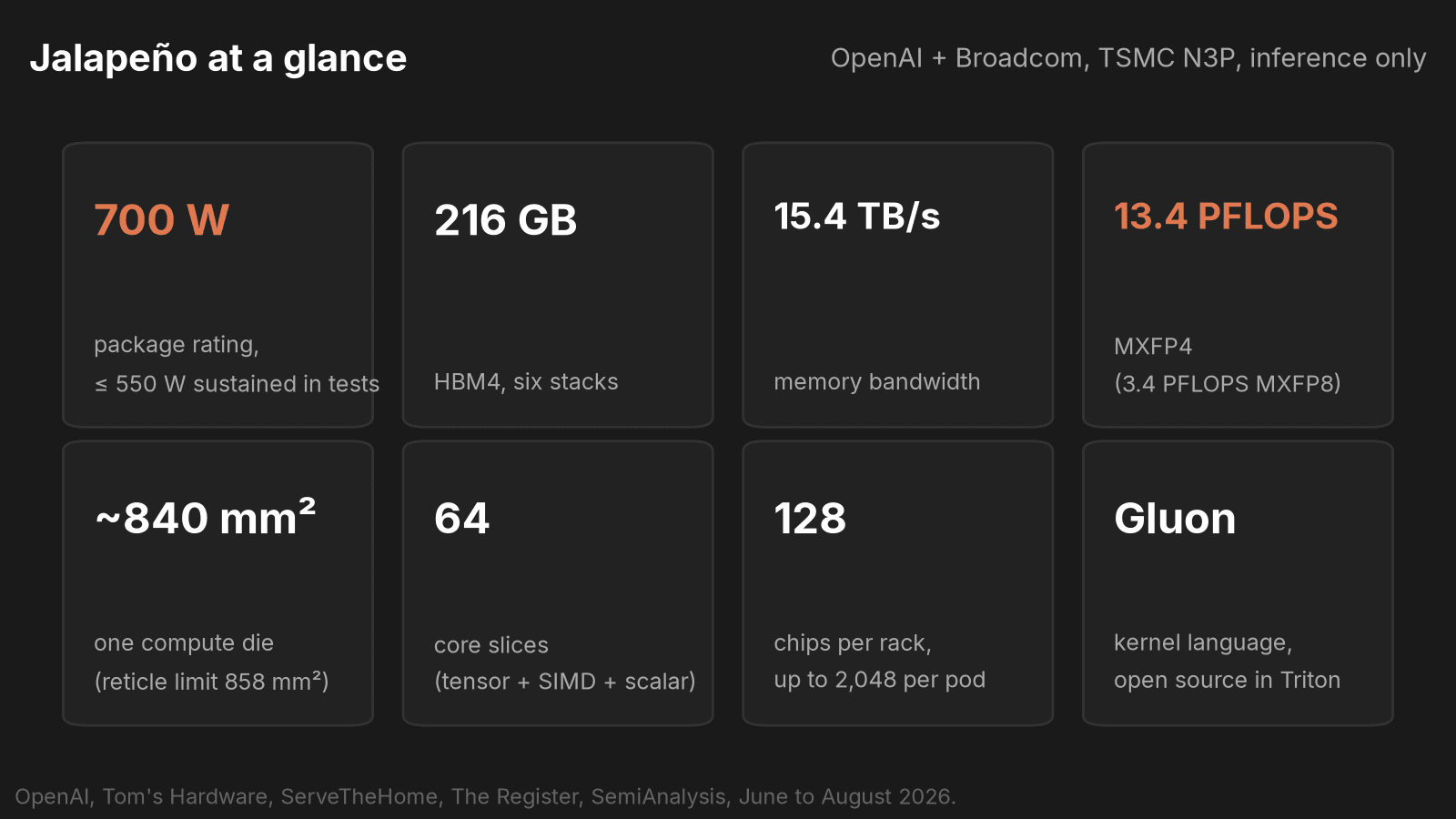
Two choices explain most of what follows. OpenAI optimises for performance per watt, because it is limited by data-centre power, not by budget. And the KV cache stays local to the chip instead of moving between prefill and decode pools, which SemiAnalysis says saves "huge power" against Nvidia and Google designs.
Nine months against twenty years
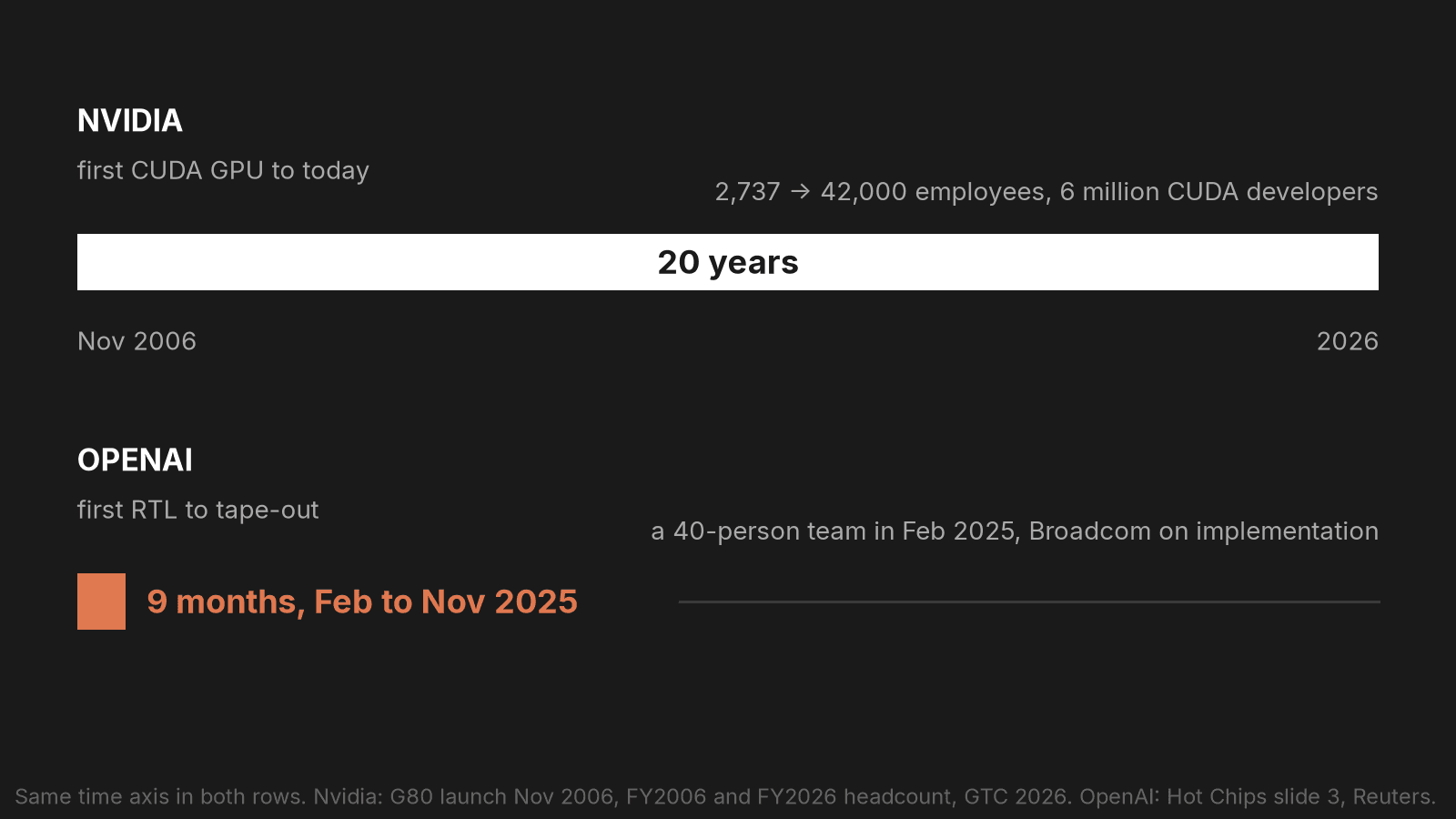
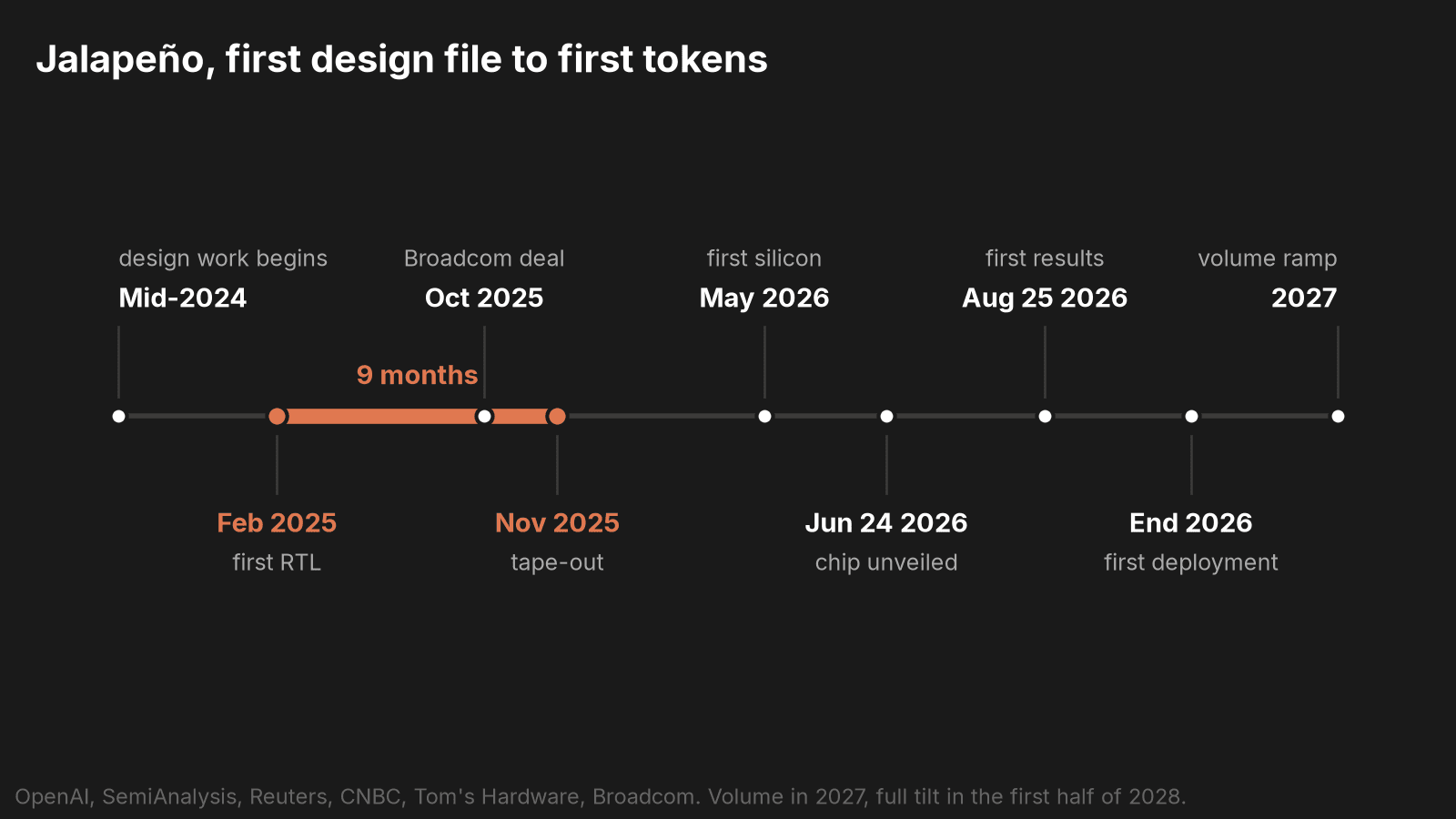
The nine months are real and they are OpenAI's own framing: first RTL in February 2025, tape-out in November 2025. Count from hiring the team and it is about sixteen months. Count from the first design work to the first production tokens and it is roughly two years. A normal ASIC takes 1.5 to 2 years to design before it reaches a fab.
Nvidia's twenty years built a platform that trains and serves every model in the industry, with a company that grew from 2,737 people to 42,000. Jalapeño is one chip, for one job, for one customer. The line is striking. It is not a like-for-like.
Per watt, Jalapeño wins
OpenAI ran SemiAnalysis's InferenceX suite on three public models it did not design, against Nvidia's GB200 (2024) and GB300 (2025) racks, normalised by each chip's power rating: 700 W for Jalapeño, 1,200 and 1,400 W for Nvidia.
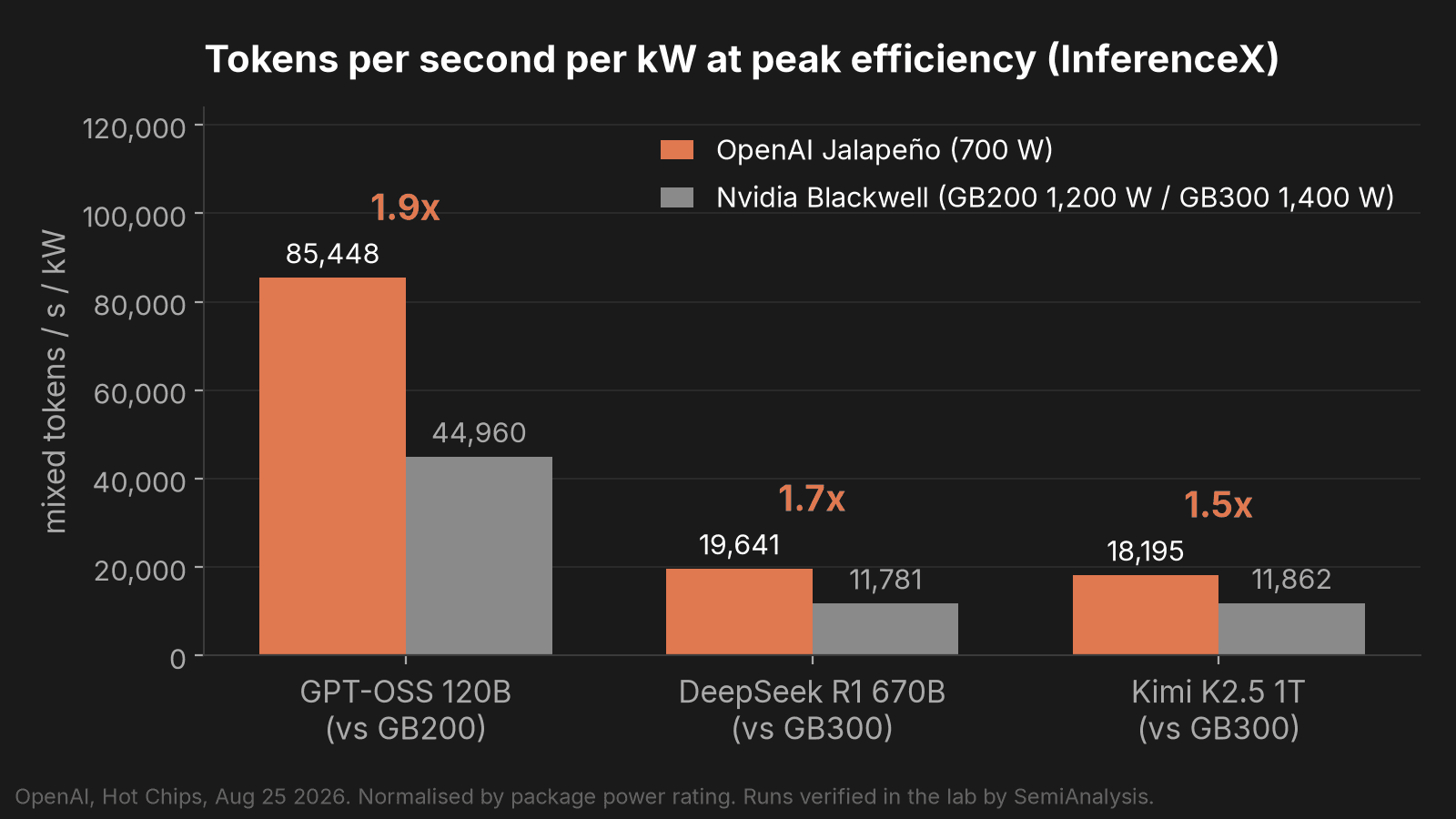
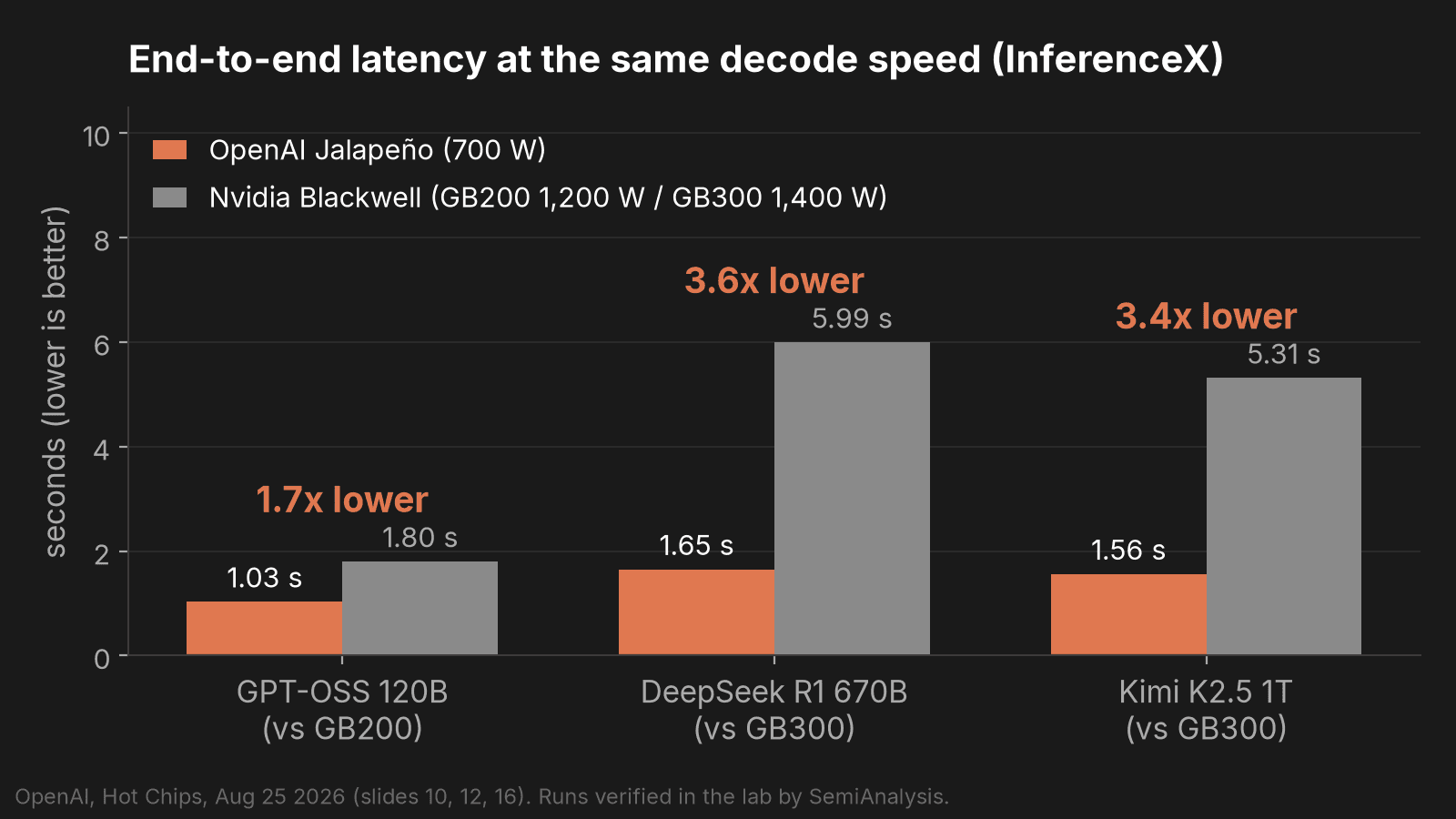
At low concurrency the gap is wider still, because Nvidia's systems fall off a cliff at high per-user speed. All of it with single-token prediction, no speculative decoding, no prefill-decode split.
Four caveats, all from the sources:
- OpenAI ran the tests. SemiAnalysis verified the InferenceX runs in person but did not run the full suite and has not seen AgentX, its long-context suite, the one closest to production traffic.
- Blackwell is last year's opponent. SemiAnalysis calls the comparison "somewhat incomplete and unfair" and says Jalapeño is really competing with Rubin.
- Package rating flatters the smaller chip. Tom's Hardware notes that against a GB300 running multi-token prediction, which Nvidia deployments commonly do, the lead shrinks to about 1.5x.
- The models are last year's too. DeepSeek V4 Pro and Kimi K3 have not been run on Jalapeño yet.
The honest headline: a 700 W first-generation chip beats Nvidia's 2024 and 2025 racks per watt. Not "OpenAI beat Nvidia".
Vera Rubin is the fair fight
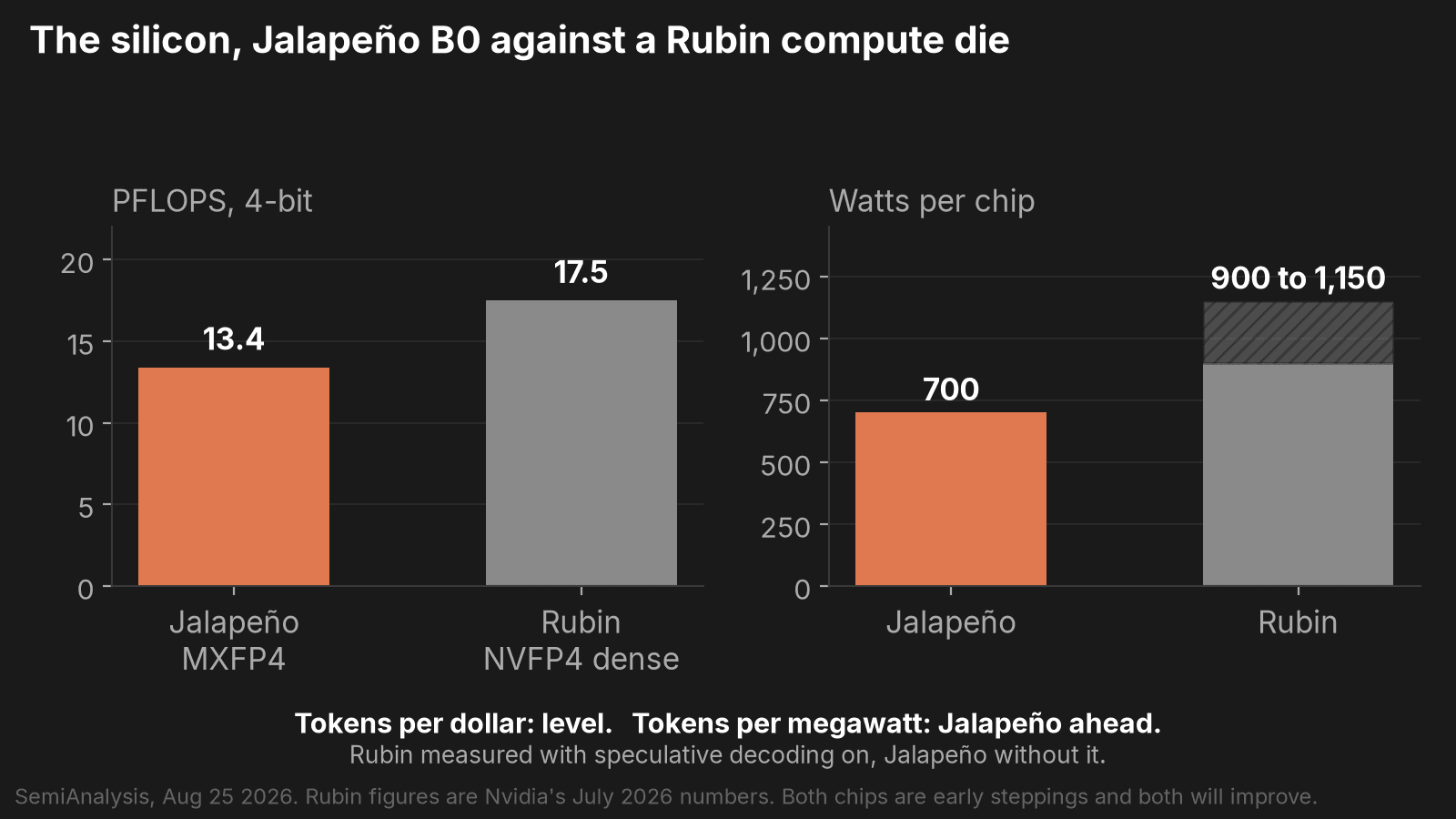
Rubin is Nvidia's HBM4 generation, in full production since June and shipping this fall. Jalapeño exists as engineering samples, with a B0 stepping in the fab worth about 25 percent more per watt. By the time Jalapeño is in volume, Rubin will have a year of software behind it. SemiAnalysis is explicit that both chips are immature and both will improve.
A chip is nothing without kernels
A kernel is the small program that runs one operation on the chip: a matrix multiply, an attention step, a routing decision. No kernel, and the model does not run. Slow kernel, slow chip. For twenty years Nvidia's edge was that every kernel anyone needed already existed for CUDA, written and tuned by people.
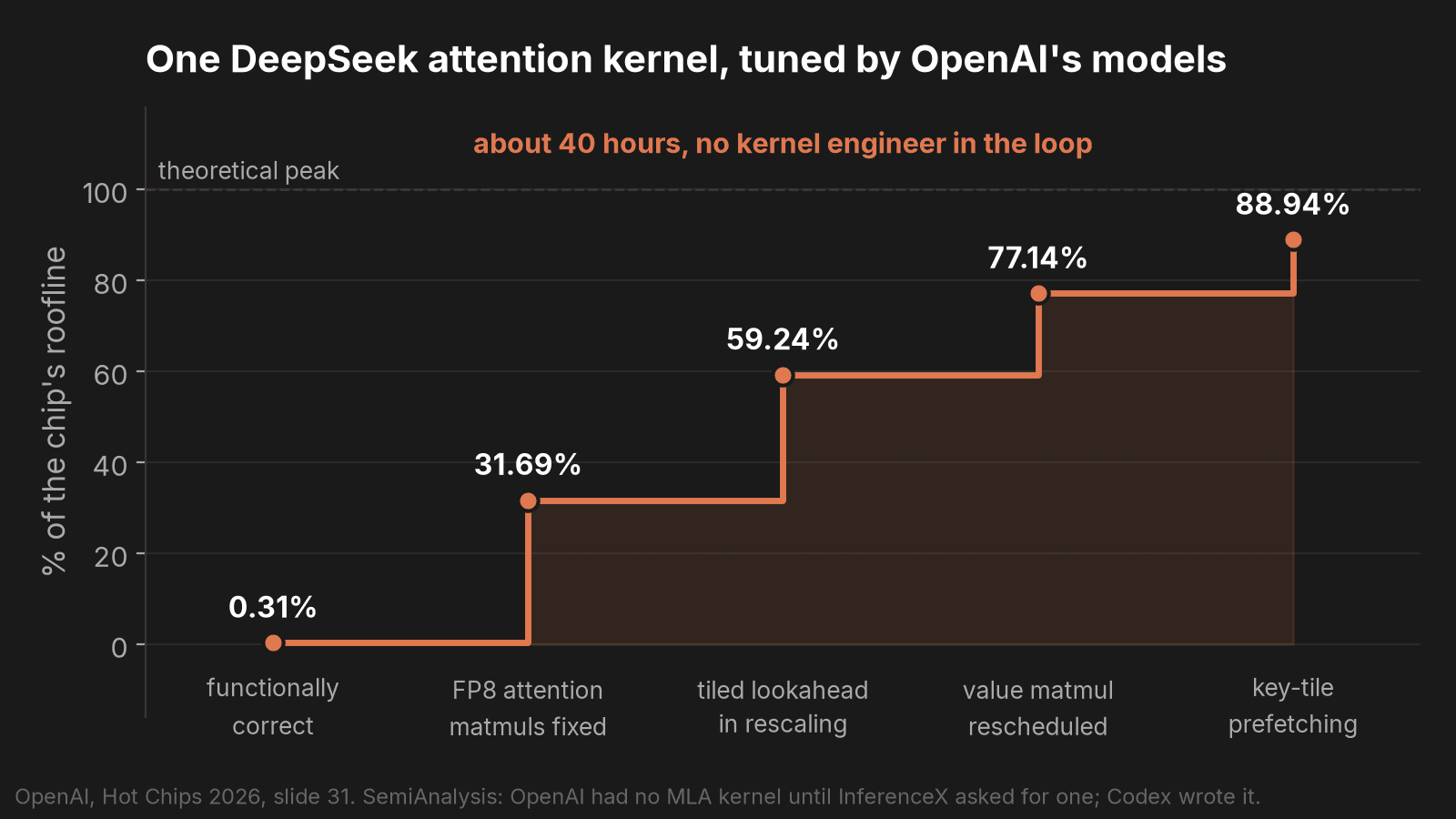
SemiAnalysis found the limit by accident. InferenceX includes DeepSeek R1, which needs a multi-head latent attention kernel OpenAI did not have. Codex wrote one "without any of OpenAI's kernel engineering team intervening", and OpenAI's models drove it to 89 percent of peak in about 40 hours. On selected GPT-OSS blocks the model-written versions ran 1.5 to 1.8 times faster than the human-expert ones, a figure OpenAI says applies to those blocks, not the whole model.
The same loop already runs on Nvidia hardware. GPT-5.6 Sol, through Codex, rewrote OpenAI's production kernels in Triton and Gluon and cut serving cost by 20 percent. The models that run on Nvidia GPUs today are writing the software for their replacement.
What Gluon is
Most coverage fuses two true things into one wrong sentence. Gluon is OpenAI's kernel language, written by people on top of Triton and open source in the Triton repository. Jalapeño is programmed in it. The kernels in it are written by models. Here is the readable end, from OpenAI's own tutorial (MIT licence):
@gluon.jit
def memcpy_kernel(in_ptr, out_ptr, xnumel, XBLOCK: gl.constexpr):
    # Each program processes the addresses [pid, pid + BLOCK_X), clamped into
    # the range [0, xnumel).
    pid = gl.program_id(0)
    start = pid * XBLOCK
    end = min(start + XBLOCK, xnumel)
    for i in range(start, end):
        value = gl.load(in_ptr + i)
        gl.store(out_ptr + i, value)
The production end is different: kernels of about 3,000 lines, hand-scheduled memory movement "like assembly", checked by a custom sanitizer. Code written to be read by a compiler and a model.
Is the CUDA moat dead?
SemiAnalysis's exact sentence: "The CUDA moat is potentially dead given how fast OpenAI can bring up new models on their silicon." Their reason is software speed, not hardware. Rubin taped out a month before Jalapeño, and Nvidia has not let them benchmark it the same way.
There are two moats inside the word CUDA.
- The ecosystem. 6 million developers, every library, code that carries from Blackwell to Rubin unchanged. Intact. Jalapeño's kernels are tuned to this chip's core count and memory layout, and the next generation needs them redone.
- The labour. Porting a frontier model to new silicon used to cost a team of scarce kernel engineers and a year, which is why Meta's and Microsoft's longer-running ASIC programmes have not gotten off the ground. If a model writes a 3,000-line kernel to 89 percent of peak in a weekend, that cost collapses, for whoever owns such a model. This is the moat SemiAnalysis is calling dead, and it is dead for frontier labs.
The counterweight. Jalapeño is not for sale. OpenAI says it "will continue to widely deploy accelerators from NVIDIA and other partners for both training and inference". Eight days before Hot Chips, Nvidia agreed to finance up to 105 billion dollars of an OpenAI-leased data-centre campus. The two companies are more entangled than a year ago.
The loop
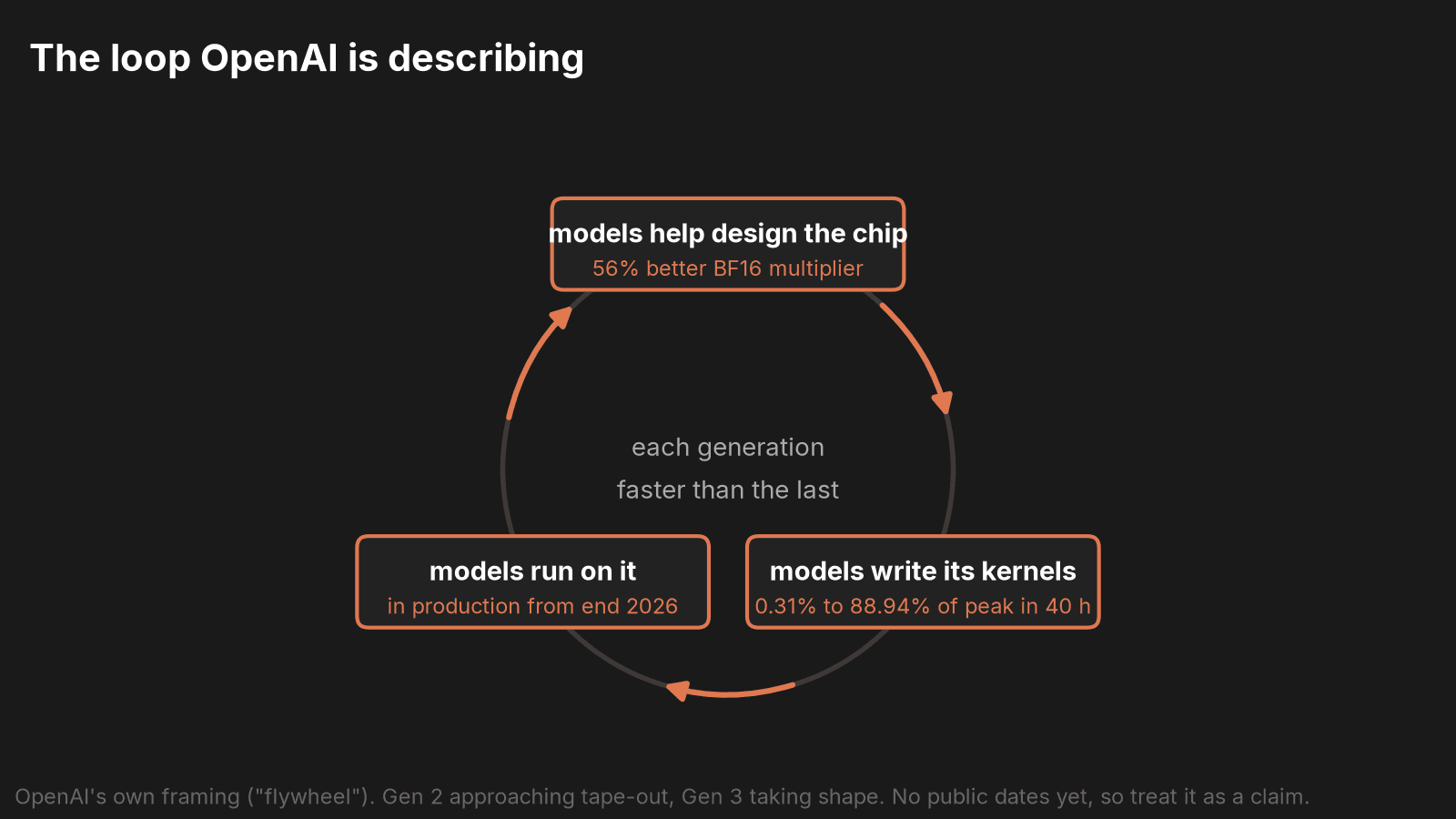
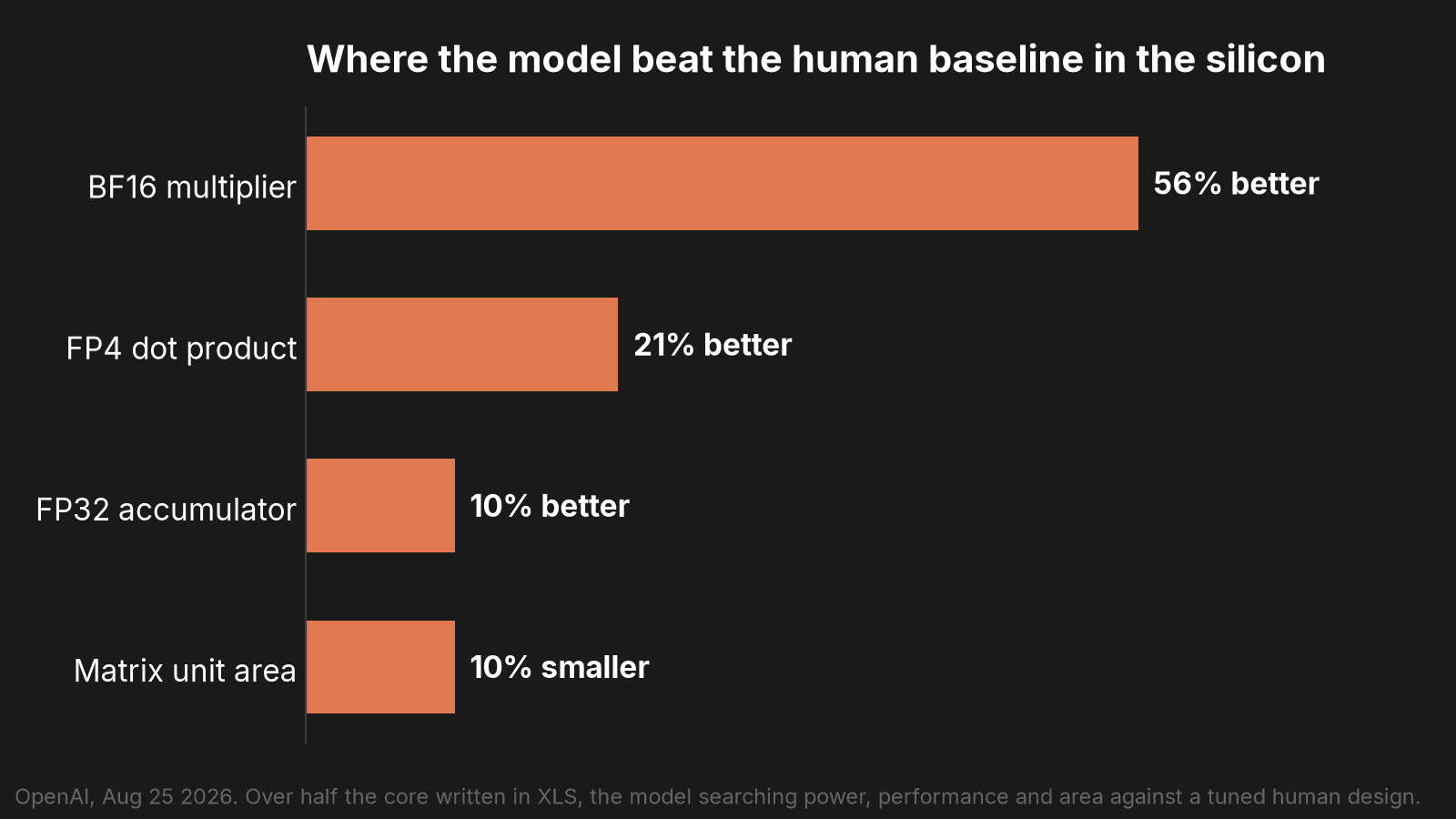
More than half of the core was written in the XLS hardware language with a model searching for power, performance and area wins, and OpenAI says it "designed the chip so AI could program it". Gen 2 is approaching tape-out, Gen 3 is taking shape. Whether each generation lands faster than the last is the thing to watch, and there is no public date for either.
If you build on these models
- Nothing changes next month. The first thing you will notice is price. Model-written kernels already took 20 percent off OpenAI's serving cost on Nvidia hardware, and a chip that does the same work at half the power is the next step down that curve.
- Kernel engineering just became a model task. It was one of the last layers where a few humans were the constraint. Low-level work with a measurable feedback loop is exactly what a model does best.
- Gluon is open. The tutorials live at
python/tutorials/gluonin the Triton repository. No Jalapeño required.
Sources
- SemiAnalysis, "OpenAI Jalapeño: Better Than Nvidia Blackwell", August 25, 2026 (paid): newsletter.semianalysis.com
- OpenAI, "Jalapeño's first results show industry-leading speed and efficiency in AI inference", August 25, 2026: openai.com/index/jalapeno-first-results
- OpenAI, "OpenAI and Broadcom unveil LLM-optimized inference chip", June 24, 2026: openai.com/index/openai-broadcom-jalapeno-inference-chip
- ServeTheHome, Hot Chips 2026 live coverage with the slides: servethehome.com
- Tom's Hardware, "Hot Chips 2026: OpenAI's Jalapeño AI ASIC unpacked": tomshardware.com
- Tom's Hardware, "OpenAI says its Jalapeño chip beats Nvidia's GB300 in first published benchmarks": tomshardware.com
- Tom's Hardware, June unveil and die-size analysis: tomshardware.com
- The Decoder, "OpenAI's first custom chip Jalapeño reportedly beats Nvidia's Blackwell and Rubin": the-decoder.com
- The Register, "OpenAI's upcoming Jalapeño chip looks like it'll be an inference beast": theregister.com
- TechCrunch, "OpenAI unveils its first custom chip, built by Broadcom", June 24, 2026: techcrunch.com
- CNBC, "OpenAI and Broadcom reveal Jalapeño", June 24, 2026, with the Brockman and Hock Tan interviews: cnbc.com
- Reuters, "OpenAI set to finalize first custom chip design this year", February 10, 2025: reuters.com
- Nvidia, "NVIDIA Vera Rubin Ramps Into Full Production", May 31, 2026: nvidianews.nvidia.com
- Nvidia developer forum, "20 Years of CUDA: Honoring the Architects of the Accelerated Age", March 24, 2026: forums.developer.nvidia.com
- TheStreet via Yahoo Finance, "How many employees does Nvidia have?": finance.yahoo.com
- The New Stack on OpenAI's GPT-5.6 efficiency post, "Kernel of truth: GPT-5.6 Sol can cut its own costs": thenewstack.io
- Gluon source and tutorials in the Triton repository: github.com/triton-lang/triton and python/tutorials/gluon
- SemiAnalysis InferenceX: inferencex.semianalysis.com
Better Apps With AI
How I use Runable, Mobbin MCP and a clear product brief to build apps with AI. Two real projects, visual breakdowns, prompts to copy, and the harness behind the work.
State of Claude Code
We analyzed 2,500 public repositories that use Claude Code. 85% ship a CLAUDE.md, but only 25% define a custom subagent. Here is how developers actually configure Claude Code in 2026: agents, skills, hooks, MCP, and how big CLAUDE.md files have grown.